
Artist: Toulouse-Lautrec French (1864-1901)
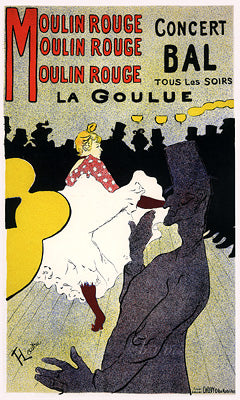
Title: Moulin Rouge - La Goulue
Plate: TL. 1
Lithograph from "Les Affiches de Toulouse-Lautrec" series.
Printed by Mourlot Freres, Paris, 1967.
Presented in 16 x 20 in. acid free, archival museum mat, with framing labels. Ready to frame. Shipped boxed flat via Fedex.
Certificate of Authenticity.
Sheet Size: 10 1/2 in x 14 1/2 in 27 cm x 37 cm
Price: Temporarily out of stock
I can usually source this poster. If you are interested please contact me. GregFull size (printed in 1891) sold for $ 241,500 US (The highest price ever paid for a vintage advertising poster) Poster Auctions International, N.Y. Nov. 1999.
During the 1960s the renowned French printer, Mourlot Freres, printed this superb series "Les Affiches de Toulouse-Lautrec" for collectors. They are reduced lithographic versions of Lautrec's most famous works. They are truly the most beautiful printing we have been able to find in this size format.
As vintage printings of Lautrec's work, in all formats, reach high prices, this mid-century printing offers a superb alternative at a reasonable price that will only appreciate in value.
View the Preliminary sketch that created this magnificent poster.
A study in three parts; "The Dancer", "The Venue", and "The Poster"
1. The rise and fall of La Goulue (The Dancer).
"Once La Goulue or 'the glutton' (Louise Weber, 1870-1929) was the most outrageous dancer of the day, her name synonymous with the Moulin Rouge nightclub. A provincial girl from Alsace who became the shameless queen of Montmarte.
She appeared at the Moulin Rouge when it first opened and danced the chalut (a form of Cancan) with her long-limbed partner, Jacques Renaudin, a wine merchant by day who at night became Valentin le Decosse, literally translated as 'Valentin the boneless'.
She earned her nickname by her habit of draining glasses dry in bars. Brought up by a laundress mother, her greatest pleasure consisted of trying on the fine clothing of the customers. At sixteen she took a job in a laundry. Her mind, however, was focused on dancing. Without her mother's knowledge she borrowed garments left by customers and made her entrance each evening at the local dance halls.
Distinguishing herself not only as a dancer but also as a laughing, extroverted high stepper, she soon attracted attention. She fell in love with the painter Auguste Renoir who introduced her to 'la louee', a popular group of models who posed nude for many artists. Through these connections she found her way to more increasingly fashionable clubs. When Joseph Oller met her, he immediately engaged her to dance 'the grand quardrille' at the Moulin Rouge. Thus she rose from anonymity to become the queen of Parisian sensuality.
She danced on tables, displayed the heart embroidered on her drawers, and removed gentleman's hats with her toe at the end of her gallop. For this she earned about 800 francs a month, not counting her touring fees. Soon a wealthy woman with a home in Montmarte and a carriage of her own, she considered herself very much the reigning queen. By 1895 she was thoroughly bored, and announced her departure from the Moulin Rouge to set up her own business. She invested an enormous sum in a fairground booth and decided to specialize in belly dancing. She believed that Paris would continue to come to her, but was disappointed in the response. La Goulue without Moulin Rouge was a failure.
Her fall was as spectacular as her rise. She drank more and spent the rest of her fortune in high living and foolish business investments, including a partnership in an animal-taming act. Alcoholic, homeless, and old before her time, in 1925 she was found toothless and white-haired in Neuilly-sur-Marne. She returned to Montmarte in 1928 selling peanuts, cigarettes, and matches on the streets near the Moulin Rouge. No one recognized the former beauty queen. She died in 1929, telling a priest that she was La Goulue" (La Goulue, Article; San Diego Museum of Art)

Moulin Rouge
2. The Moulin Rouge (The Venue) "On October 5, 1889, the Moulin Rouge opened as the 'rendez-vous du high life' at the foot of Montmarte. At once it's illuminated windmill vanes became a landmark, rotating above rooftops on the boulevard de Clichy.
A combined dance hall and cabaret, it housed a big dance floor, mirrored walls, and a fashionable gallery lit by round glass globes of gas lamps mounted throughout the interior. In the garden were an outdoor stage and an enormous wooden elephant, with interior stairs leading to a glass-enclosed howdah, tame monkeys and donkeys that ladies would ride after removing their stockings.
Masked balls were featured on Wednesdays and Saturdays. The music was a brassy accompaniment to various new forms of the risque Cancan which shocked some visitors. Professional dancers appeared on the floor described in the '1898 Guide des Plaisirs á Paris' as 'a host of young girls who are there to demonstrate the heavenly Parisian Chahut dance as its traditional reputation demands…with a physical elasticity as they do the splits, which promises just as much flexibility in their morals.' Now and then, a representative from the police moral squad had to be on the watch to be sure the chahuteuses (Cancan dancers) were wearing underwear. The most famous of the nightclub's dancers were Jane Avril and La Goulue " (The Moulin Rouge, Article; San Diego Museum of Art)
3. "Moulin Rouge" by Toulouse-Lautrec (The Poster)
"When Toulouse-Lautrec started learning the art of lithography, he mentioned it to Charles Zidler, the director of the Moulin Rouge, who immediately offered to let him prepare a new poster of the caberet, to replace Cheret's which had been in use for two years (see PL.53). The artist rose to the occasion, with the result that the first poster as well as the first lithograph he ever made (he was 27 years old) turned out to be his biggest, best and most successful. It extended his already considerable fame beyond the confines of the art circles to the broadest cross section of the public, and made him an instant popular celebrity.