
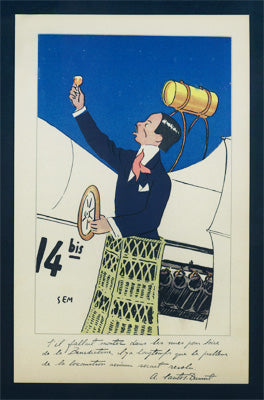
Artist: Sem (Georges Goursat) French (1863-1934)
Title: Santos-Dumont
Plate: sem.03
Original Pochoir (Hand coloured) lithograph from "Celebrites Contemporaines et la Benedictine", by Sem.
Printed by Devambez, Paris ca.1900.
Signed in the plate lower left.
French Text by Santos-Dumont at bottom reads,"Had one needed to get up to the clouds to drink Benedictine, the mysteries of powered flight would be long solved. A. Santos-Dumont "
Presented in 16 x 20 in. acid free, archival museum mat, with framing labels. Ready to frame. Shipped boxed flat via Fedex.
Certificate of Authenticity.
S
Sheet Size: 6 1/4 in x 9 1/2in 16 cm x 24.5 cm
Price: Temporarily out of stock
I can usually source this poster. If you are interested please contact me. Greg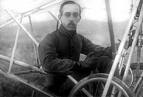
Alberto Santos-Dumont Brazil (1873 - 1932) The Brazilian aviation pioneer, deemed the Father of Aviation by his countrymen.
"Alberto Santos-Dumont was a wealthy Brazilian aviation pioneer who came to Paris, France, at the age of 18 to live and study. He attempted his first balloon ascent in 1897 and had his first successful ascent in 1898. He began to construct dirigible airships powered with gasoline-powered engines in 1898 and built and flew fourteen of the small dirigibles. In 1901, he flew his hydrogen-filled airship from St. Cloud, around the Eiffel Tower, and back to St. Cloud. It was the first such flight and won him the Deutsch Prize and a prize from the Brazilian government. In 1902, he attempted to cross the Mediterranean in an airship but crashed into the sea. After the Wright brothers' flights in 1903, Santos-Dumont began to experiment with heavier-than-air machines. He constructed a vertical-propeller model, and, in 1906, built a machine, the 14-bis, on the principle of the box kite. In October 1906, he won the Deutsch-Archdeacon Prize for the first officially observed heavier-than-air powered flight in Europe, flying his canvas and bamboo biplane. In November 1906, he flew 725 feet (220 meters) in 21 seconds. In 1909, he produced his "Demoiselle" or "Grasshopper" monoplane, the precursor to the modern light plane. He returned to Brazil in 1928. (www.centennialofflight.gov)
"I would like . . . to group in a series of albums all the celebrities of the day, only the most illustrious and famous names. But to bring together so many important people, so occupied and not easily mobilized, I feared that my modest talent was not a sufficient enough attraction . . . So, to convince them, I had the idea to offer to them a glass of famous Benedictine . . . And, indeed, all answered my invitation with a unified eagerness as if I was flattering them." Sem
"So begins the introduction to Sem's eight-lithograph collection of celebrities praising the virtues of the liqueur, including famed aviator, Santos-Dumont, composer Massenet and actor Albert Brasseur. The career of caricaturist Sem started modestly enough in his home town of Perigueux where he published his first collection of local celebrities' portraits in 1895. Only after doing the same for Bordeaux in 1897 and Marseilles in 1898 did he venture to Paris where he charmed the city folk with his talent. Hardly anyone of note escaped being captured for posterity." (Rennert, PAI-XXVI, 557)

Benedictine
"In 1863, Alexandre Le Grand, a distant relation of the Fécamp notable, came across the book of spells by chance and discovered the secret recipe. Straight away, he decided to decipher it in order to re-create this mysterious liqueur. His tenacity enabled him eventually to do so. He modernised the recipe and called it "Benedictine". The liqueur soon became extremely popular: by 1873, production had reached almost 150,000 bottles a year. In light of this success, Alexandre Le Grand decided to set up the Benedictine SA company in June 1876, with capital of 2,200,000 francs. In 1882, Alexandre Le Grand decided to have a unique building built in Fécamp to house the distillery: a Palace-Museum. It is here, in this extraordinary place, that the famous liqueur is still made today." (Benedictine.fr)
Pochoir, French for stencil, defines a technique of print making popular in France in the early 1900s. It is a labor intensive process of applying brilliant color by hand using a series of cutout stencils. Each plate is an original print using up to thirty stencils in one image. All are hand colored and most are signed in the plate by the illustrator.