
Artist: Henri Meunier Belgian (1873-1922)
Title: Gonthier-Meymans (before text)
Plate: PM.18
Original lithograph from the "Das Moderne Plakat" series, View entire collection (50)
Printed by Verlag von Gerhard Kuhtmann, Dresden, 1897.
Presented in 16 x 20 in. acid free, archival museum mat, with framing labels. Ready to frame. Shipped boxed flat.
Certificate of Authenticity.
Sheet Size: 9 in x 12 in 23 cm x 30.5 cm
Price: Temporarily out of stock
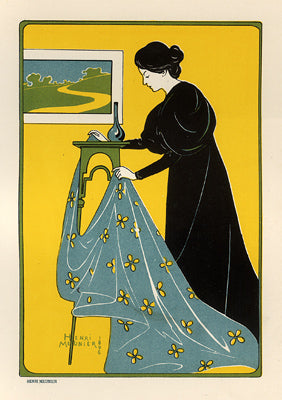
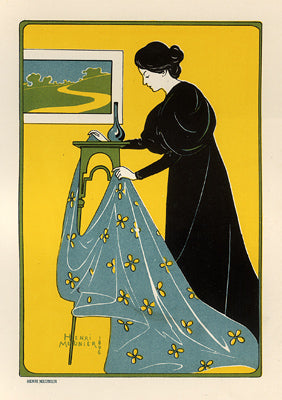
I can usually source this poster. If you are interested please contact me. Greg"This poster for a Brussels firm specializing in the 'Three Fs' Furnishings, Fabric and Framing, illustrates in nearly textbook fashion the spectacular simplicity with which the designer delivered his artistic good. From the fluid planes of flat color to the uncluttered detailing to the clever touch of advertising a framer with an unobtrusive bare-bones frame, the resulting image creates a visual attraction that seduces without a single note of anything overtly sensual." (Rennert XXXII, 411)
"As a poster designer, Meunier knew how to organize well-observed detail to create an almost musical ambiance…by compositions that are gravely meditative, clean and synthetic… The Son of Belgian engraver Jean-Baptiste Meunier and nephew of sculptor Constantin Meunier, Henri seems to have come by his artistry in a genetic fashion. After completing brilliant studies at the academy in his native Ixelles, he went on to pursue many fields: printmaker, poster designer, graphic reporter and book binder. Oostens-Wittamer characterizes his poster work as focused on bringing out opposing light and dark values within his often large, contained, flowing masses of color... The poster for Ysage concerts at the end of 1895 is considered to be the first made by Meunier" (Belle Epoque 1970 p.68)
"Henri Meunier was an artist of exceptional purity. He took flat colours in flat tints and his thick outlines from Japanese prints to construct strong and clear images: 'With two or three pure colours, he fixes an impression that penetrates and imposes itself like the truth' justly notes Demure de Beaumont."(Weill, p.60)