
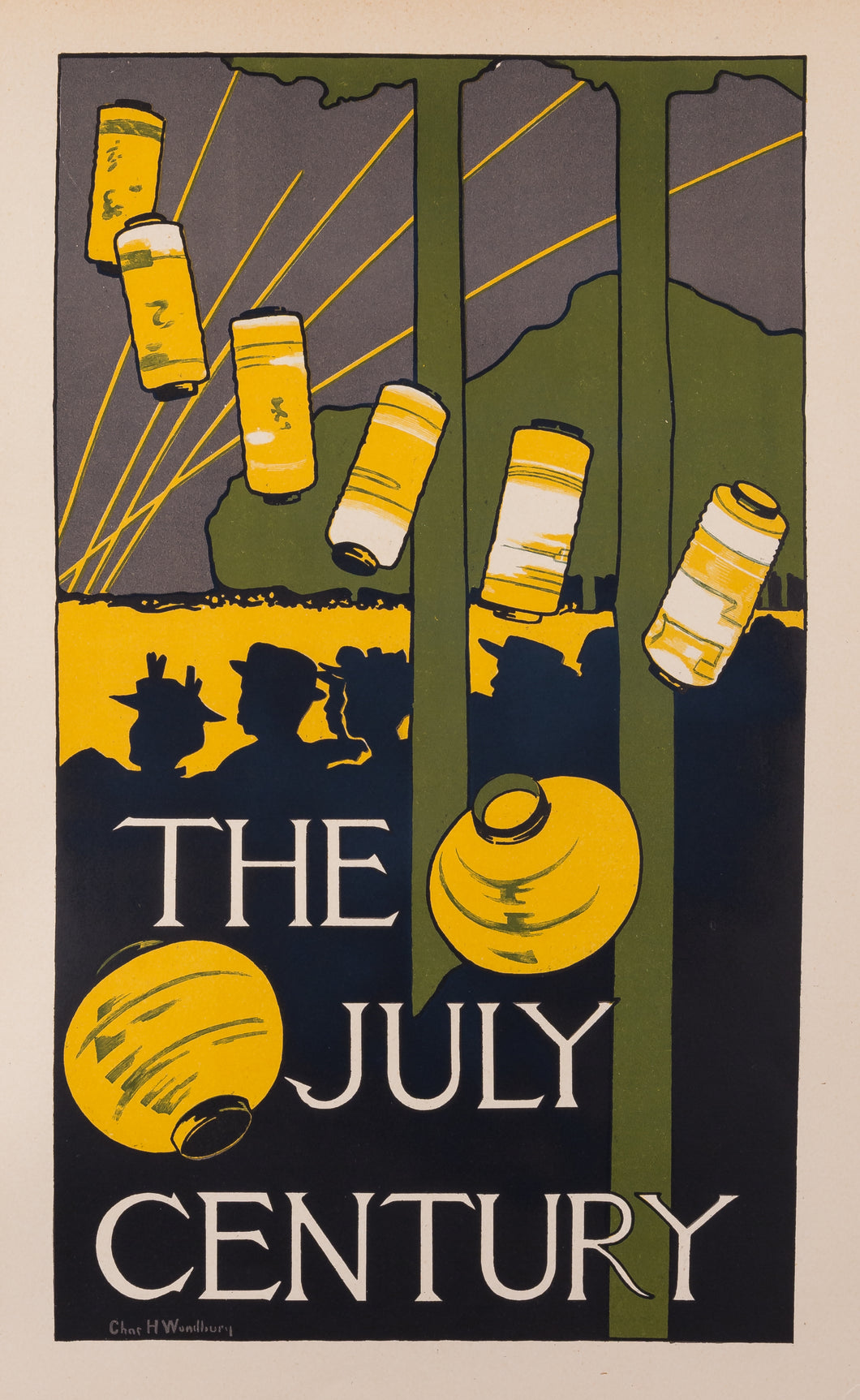
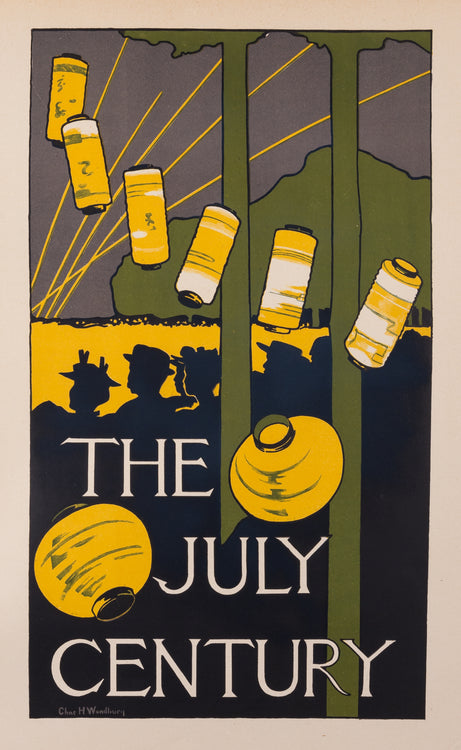
Artist: Charles H. Woodbury American (1864-1940)
Title: The Century Magazine
Plate: PL. 32
Original lithograph from "Les Maitres de L'Affiche" series.
Printed by Imprimerie Chaix, Paris, 1896.
Presented in 16 x 20 in. acid free, archival museum mat, with framing labels. Ready to frame. Shipped boxed flat via Fedex.
Certificate of Authenticity.
Maitre Sheet Size: 11 3/8 in x 15 3/4 in 29 cm x 40 cm
Price: $175.00
"W. Lewis Fraser, the head of the Century Company's art department, commissioned this poster after seeing Woodbury's (first) poster for the Exhibition of the Society of Painters in Water-Colour of Holland (see PL.112)" (Lauder p.182)
"The rich effects of his poster designs were conveyed by the disposition of sharp lines and flat areas of limited colour. Like Dow (see PL.36), another native Massachusetts artist, Woodbury founded his sense of design on familiarity with Japanese art, championed by Fenollosa at the Museum of Fine Arts, Boston. Woodbury's six posters received favourable comment from American and European critics" (Lauder p.192)

Charles H. Woodbury was born in Lynn, Massachusetts, where his earliest work was part of the oeuvre of the group later known as the Lynn Beach Painters. While an undergraduate at MIT he became a regular exhibitor at, and at 19 the youngest member of, the Boston Art Club.
After graduation from the (with degree in [Mechanical Engineering]), in 1886 Woodbury had great success painting up the New England coast and in the towns and beaches of Nova Scotia and exhibiting the results. From January to June 1891 he was a pupil of the Académie Julian in [Paris], after whaich he went to Holland, where he studied the techniques of the modern Dutch painters.
Upon his return to New England he settled in Boston for his winter studio and spent his summers in the small fishing village of Ogunquit, Maine; there he founded one of the most successful of the summer art colony schools that even survived his death.
He was one of the most sought-after teachers of his generation, having begun teaching on a regular basis while a freshman at M.I.T. Ironically, he had little formal training himself other than a few months of classes at the Academy Julian in Paris.
Like Winslow Homer, another New England painter with an affinity for summers in Maine, he preferred "to work out his salvation with little help from others in his profession". Nevertheless, Woodbury maintained a close friendship with John Singer Sargent and a pleasant acquaintance with many of his contemporaries including J. Alden Weir and Childe Hassam. He was president of the Boston Water Color Club, and became associate of the [National Academy of Design], New York in 1906 and a full member in 1907. (Encyclopædia Britannica, Eleventh Edition)