
Artist: Toulouse-Lautrec French (1864-1901)
Title: Chaine Simpson
Plate: PL. 238
Original lithograph from "Les Maitres de L'Affiche" series.
Printed by Imprimerie Chaix, Paris, 1900.
Presented in 16 x 20 in. acid free, archival museum mat, with framing labels. Ready to frame. Shipped boxed flat via Fedex.
Certificate of Authenticity.
Maitre Sheet Size: 11 3/8 in x 15 3/4 in 29 cm x 40 cm
Price: $1100.00
Same size and version sold for $ 3.840 US Swann Auctions N.Y. Feb. 2010
Full size sold for $ 41,400 US Poster Auctions International, N.Y. May 2005.
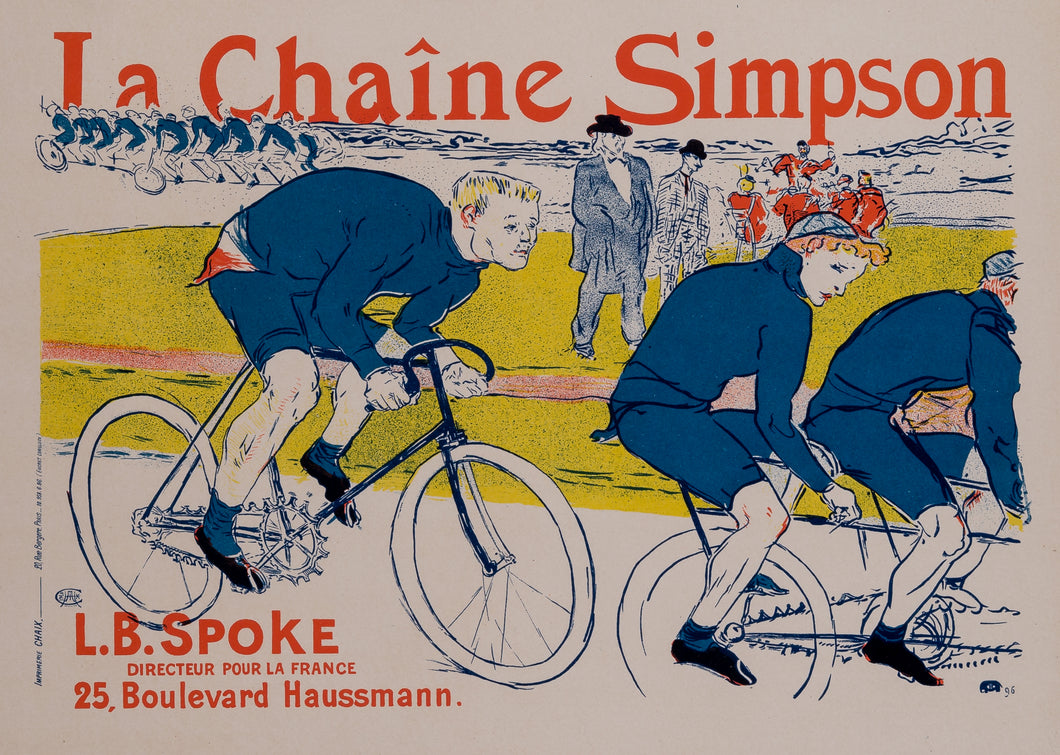
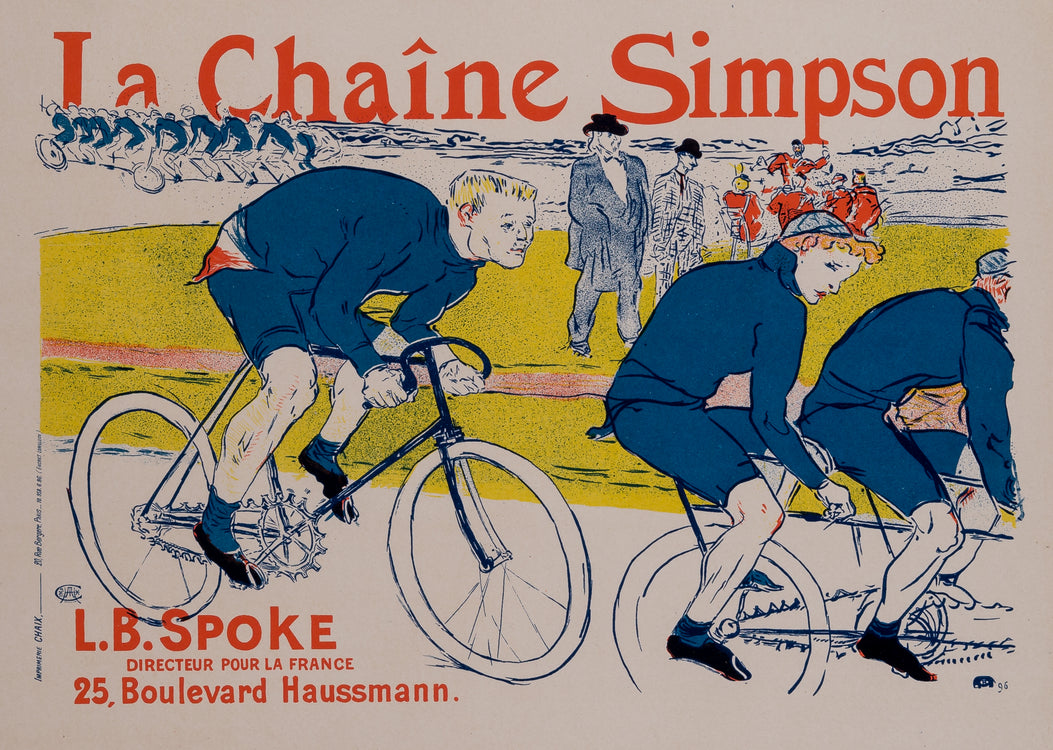
"In her recent excellent biography of Lautrec, Julia Frey indicates that 'Henry, the frustrated athlete, was compulsively familiar with the vocabulary and technical aspects of a variety of sports in which he could participate as a spectator: horse and bicycle racing, wrestling, yachting, bullfighting. He watched them all with the same intensity that he watched a line of dancers or a circus bareback rider, attracted by the beauty of movement, but also by the smells, sounds and excitement of the spectacle (Frey, p.353) His 'insider' knowledge of the cycling field shows up abundantly in this poster for the French agent of the Simpson bicycle chain company. In the foreground is the champion cyclist Constant Huret.
-
 Constant Huret
-
 Tristan Bernard
-
 Louis Bouglé
In the background are Tristan Bernard, the sports impresario who was a close friend of Lautrec, with Louis Bouglé, the French agent who adopted the name 'Spoke.' A touch of levity is added by what appears to be a 'bicycle-built-for-ten' in the upper-left corner, in fact it's two five-seaters, known at the time as 'quints.'"(Rennert, PAI-XXII, 35)
"The bicycle was all the rage in Paris in the 1890s, whether for sport or leisure. Lautrec's poster for the bicycle chains made by the Simpson company shows a race scene involving teams of riders on machines with several saddles, as well as at least one rider cycling alone; the implication is perhaps that the Simpson chain gives one man the power of many. "L.B. Spoke" was the name of the bicycle store run by the Simpson representative in France, Louis Bouglé. This is Lautrec's second try at the commission for Bouglé, and is more successful in every way than the initial design:

He not only revised the chain to an accurate scale (responding to Bouglé's objection to the first proposal) but infused the scene with the excitement of a race, complete with band playing in the infield. The first attempt depicts a training scene, while here dozens of cyclists are buzzing around the track, hunching over in keen competition, with a feeling of energy and speed that by contrast makes Jimmy Michaël in the first design appear stationary. Lautrec added to the illusion of velocity by allowing some of the wheels to disappear into invisible spins. This second poster met with Bouglé's approval." (San Diego Museum of Art)

"I remember seeing a grainy b&w photo of a beautiful young racer girl using the Simpson Chain. When I saw Lautrec's rendition, I assumed this was a non-cycling artists interpretation of the chain, but I was pleasantly surprised to see in the photo the chain really DOES look as Lautrec depicted!
Doubting Lautrec was foolish on my part, because, as I later learned, he was an avid fan of cycling (and several other sports). Lautrec was a keen observer of these events and often seen trotting up and down alongside the track to get closer views of the athletes, their equipment and the progress of the competition. It is well known that he captured and rendered most details quite accurately.
The Simpson Lever Chain riding cyclist drafting on the similarly equipped tandem is Constant Huret. The tandems are "quints", or five-seaters, which were popular as draft vehicles before the derny. The men in centerfield are William Spears Simpson and Louis "Spoke" Bouglé."
The racer in the photo was the Belgian track cyclist "Hélène Dutrieu" who later became the first woman licensed to fly an airplane in Europe."(http://cycling.ahands.org/simpson.html)