
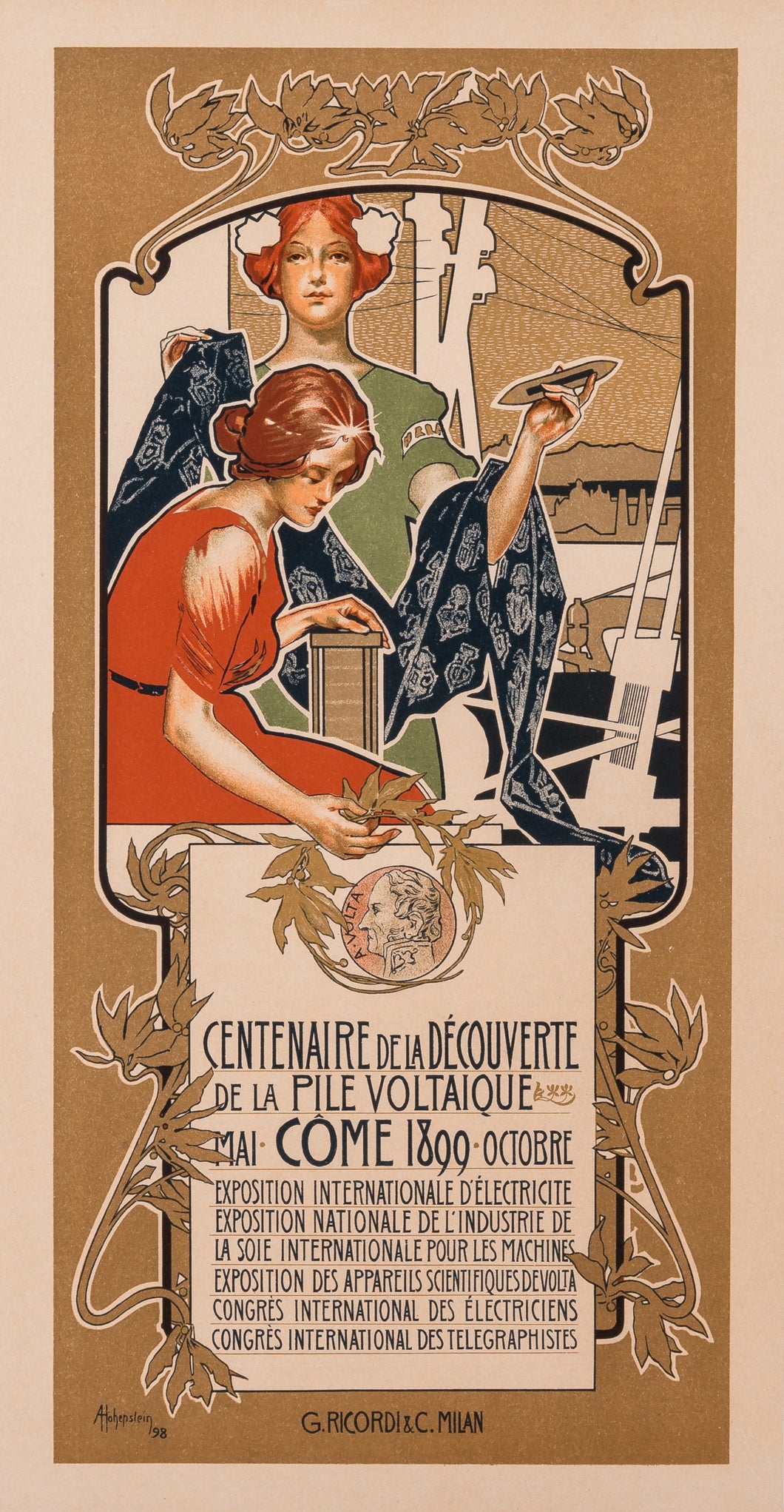
Artist: Adolfo Hohenstein German (1854-1928)
Title: Centenaire de la Decouverte de la Pile Voltaique
Plate: PL. 160
Original lithograph from "Les Maitres de L'Affiche" series.
Printed by Imprimerie Chaix, Paris, 1899.
Presented in 16 x 20 in. acid free, archival museum mat, with framing labels. Ready to frame. Shipped boxed flat via Fedex.
Certificate of Authenticity.
Maitre Sheet Size: 11 3/8 in x 15 3/4 in 29 cm x 40 cm
Price: Temporarily out of stock
I can usually source this poster. If you are interested please contact me. Greg"Two young women with the symbols of manual labor (a shuttlecock and a washboard) place a wreath around the cameo of Alessandro Volta (1754-1827), to indicate their gratefulness for his electricity that liberates them from drudgery. The poster is for an exhibition of electrical products being held in honor of the 100th anniversary of the birth of Volta, the inventor of an instrument for measuring electricity (voltmeter), and the man who defined a single unit of it, a volt, as "the electron drive force which, when applied to the conductor with the resistance of one ohm, produces a current of one ampere." That so impressed Napoleon that he made him a count as well as a senator of Lombardy" (Rennert PAI-XXXVI, 353)
The poster advertises an exhibition celebrating the centennial of the invention of the electric battery by Volta
"Hohenstein can stand as a father to the Italian poster…His figures were treated with impeccable photographic realism, and colours with a palette of dazzling richness which plays with the effects of light and shade. From the beginning, the boldness of his posters left the French poster artists far behind…With all the flamboyance and excess of the Italian temperament, he played with forms and colours…The virtuosity with which he makes figures emerge from an overloaded frame…They (his posters) all have the same freedom, the same richness of invention in layout and ingenuity of the lettering"(Weill p.84)