
Artist: Sir William Nicholson English (1872-1942) Also known as Beggarstaff along with James Pryde, Scottish (1866-1941)
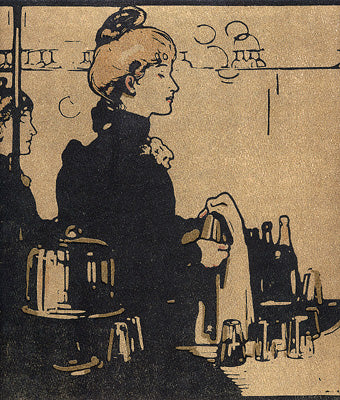
Title: Barmaid
Plate: NLT. 03
Original Lithograph from "London Types"
Printed by William Heinemann, London 1898
View the Complete Set and more works at the Nicholson Collection
Sheet Size: 10 3/8 in x 13 in 26.4 cm x 33 cm
Price: $250.00
Any Bar by W.E. Henley (British poet, 18949-1903) from "London Types"
Though, if you ask her name, she ELISE,
Being plain ELIZABETH, e'en let it pass,
And own that, if her aspirates take their ease
She ever makes a point, in washing glass,
Handling the engine, turning taps for tots,
And countering change, and scorning what men say,
Of posing as a dove among the pots,
Nor often gives her dignity away.
Her head's a work of art: and, if her eyes
Be tired and ignorant, she has a waist;
Cheaply the mode she shadows; and she tries
From penny novels to amend her taste;
And, having mopped the zinc for certain years,
And faced the gas, she fades and disappears.
"Nicholson’s portfolio of London characters anticipated even the boldest of contemporary graphics with an approach to design that pulled no punches. Little wonder, then, that by the turn of the century, and at the age of just twenty-six, he was touted as Britain’s greatest living printmaker." (goldmarkart.com) Un bar aux Folies Bergère by Edouard Manet 1882
"William Nicholson's woodblock prints of the 1890's were amongst the most revolutionary British print images of the era. They used a treatment of form, with a stylised simplification of shape, and a handling of perspective and picture space which had had no precedent in British art. Influences of Japanese art, and a parallel thinking to, if not a direct knowledge of, the ideas of Toulouse Lautrec and of the Nabis painters in Paris at the same period can certainly be felt, although there is no record that Nicholson had actually studied either at this date.
One of the most famous of the groups of prints that Nicholson cut at this period was the series known as 'London Types'. This was made at the instigation of William Heinemann, who published all William Nicholson's early prints. The series portrays typical figures from London life of the period. Such as the girls who sat with the baskets of flowers for sale who were a familiar sight near 'Rotten Row' where the fashionable people of London society rode out on their horses at the edge of Hyde Park by Park Lane. The impressions of this popular edition were printed by taking a transfer from his woodblock onto a lithographic stone and adding lithograph colour" (Weston)