
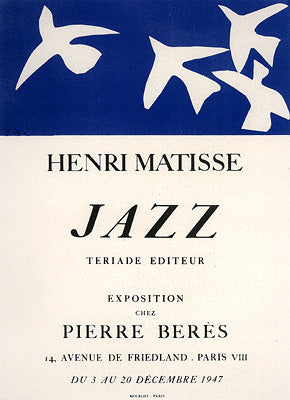


Artist: Henri Matisse French (1869-1954)
Title: Matisse Jazz, Pierre Beres Gallery. December 1947
Plate: MP. 39
Lithograph
from the "Affiches Originales" series.
Printed by Mourlot Freres in Paris, 1959.
Signed in the plate.
Presented in 16 x 20 in. acid free, archival museum mat, with framing labels. Ready to frame. Shipped boxed flat via Fedex.
Certificate of Authenticity.
Sheet Size: 9 1/4 in x 12 1/2 in 23.5 cm x 32 cm
Price: $250.00
"Matisse's Jazz featured subjects that related to his memories of the circus, to popular stories and myths and to the journeys he took earlier in life. Performance artists, Tahitian lagoons, and most notably, the mythical figure Icarus, are represented in the body of work. In book form, these magnificent works of art are interspersed with Matisse's own handwritten 'comments on notes taken during my life as a painter.' In Jazz, the images and text are very personal expressions of Matisse's imagination, reflecting the various feelings and inspirations that contributed to his artistic expression. He chose the title Jazz, because he felt it expressed the kind of harmony he improvised from all of these elements, similar to the way jazz musicians improvised much of the music they performed in the world around him" (Louisiana State Museum)
"The abstracted simplicity of form and the flat areas of colour pattern which Matisse created with collages of paper during the period at the beginning of the 1950's mark one of the most inspired moments in his career as an artist. Rhythms of colour used in a manner which went far beyond the merely visual had been a vital element of his art from some 25 years earlier. However it was in the period of the 'cut-paper' compositions that he was able to see a way of taking them even further into the area of an independent non-descriptive, effectively abstract, role... All the prints from this 'cut-paper' period were created by Matisse making a 'maquette', which was then transferred to lithographic stones at the studio of Mourlot." (Weston)
During the 1950s the renowned French printer, Mourlot Freres, printed most of the "original" posters of the most important artists of the day. In 1959 they printed the series "Affiches Originales" for collectors. They are reduced lithographic versions of the "original" posters created by the contemporary masters, Picasso, Chagall, Braque, Matisse, Miro, Leger, and Dufy.