
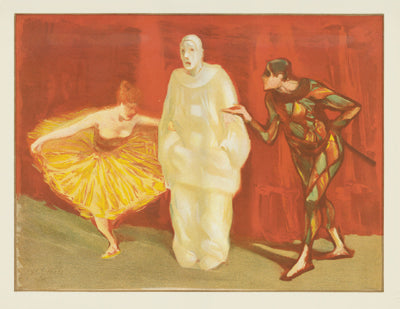
Artist: Henri-Gabriel Ibels French (1867-1936)
Title: Pantomime
Plate: em62
Original Lithograph,
issued by L'Estampe Modern, August 1898,
Printed by F. Champenois, Paris.
Blindstamp lower right in margin.
Presented in 16 x 20 in. acid free, archival museum mat, with framing labels. Ready to frame. Shipped boxed flat via Fedex.
Certificate of Authenticity.
Maitre Sheet Size: 12 in x 15 3/4 in 31 cm x 40 cm
Price: Temporarily out of stock
I can usually source this poster. If you are interested please contact me. Greg"A member of the Nabi group of artists, Ibels shared with the others a stylistic debt to Gauguin, but diverged from the esoteric, symbolist interests, preferring to depict directly and honestly the popular life of the streets"(Rennert, PAI-XXVII, 461)
Not unlike the Maitre de L'Affiche series, L'Estampe Modern was a portfolio printed between 1897-98, published by Imprimerie Champenois, Paris, contained 24 monthly portfolios, with four original lithographs in each. Each commissioned only for this series. As well as Mucha, some of the contributing artists included Rhead, Meunier, Ibels, Steinlen, Willette and Grasset. This is from the series with the blindstamp in the margin lower right corner.
Ibels’ works were bold and expressively graphic, typical of the artists of these movements in that their work included not only fine art, but early forms of graphic design and advertising as well, as viewed in lithographs and posters for theaters and cabarets, and book illustrations (Gauguin, Utrillo, and Ibels). His art was inspired by contemporary life, with subjects drawn from the spectacle of modern Paris, particularly from the café, circus and boxing ring. Both in subject and technique he can be likened to such artists as Adolphe Willette, Henri de Toulouse-Lautrec (who was his friend and began lithography at Ibels’ insistence) and Théophile-Alexandre Steinlen, and his work shares many characteristics with theirs, notably an economy of line and simplicity of shapes and colors. Such features derived in Ibels’ case from the art of Honoré Daumier, Japanese printmakers and Paul Gauguin and the Pont-Aven group.