
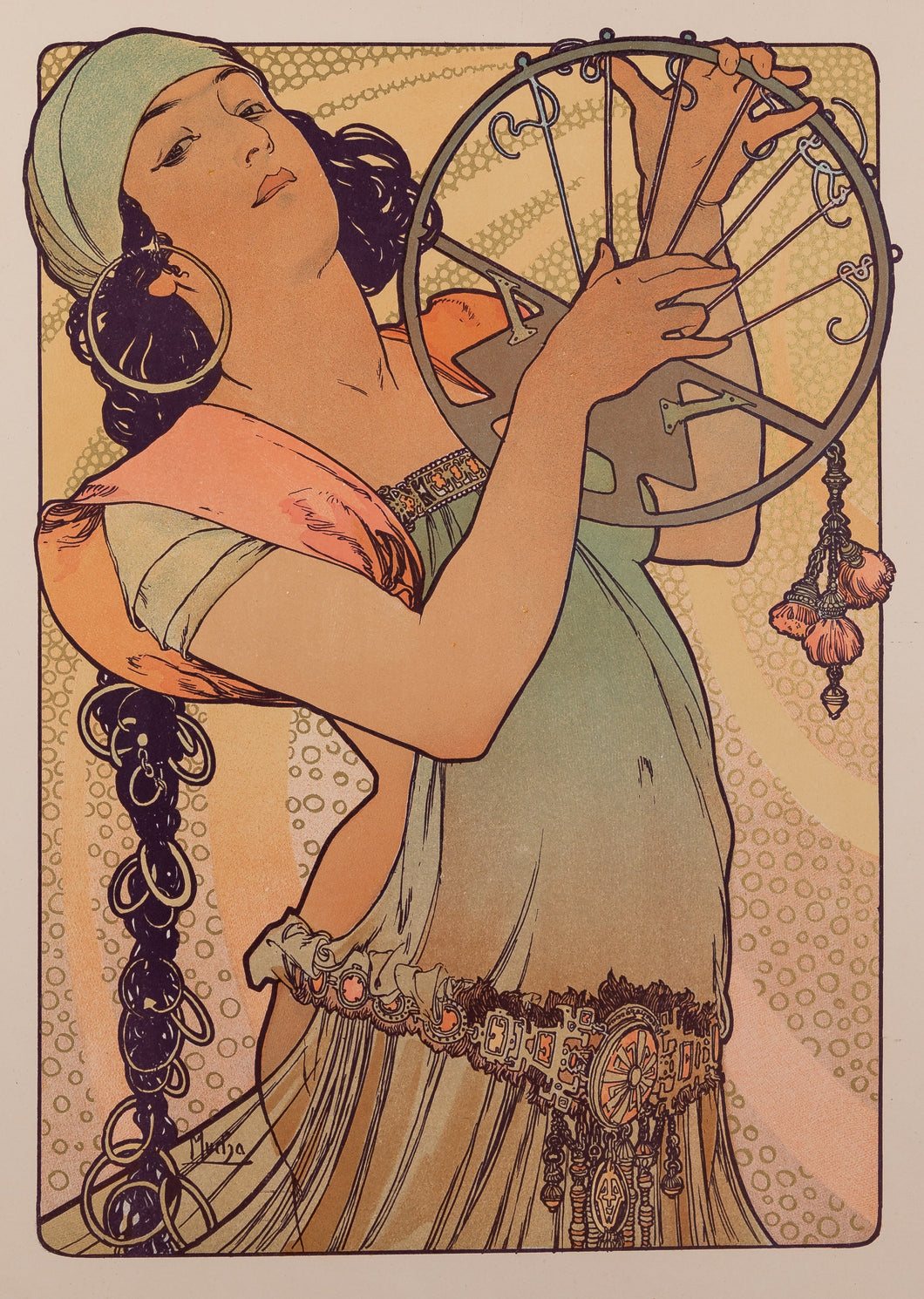

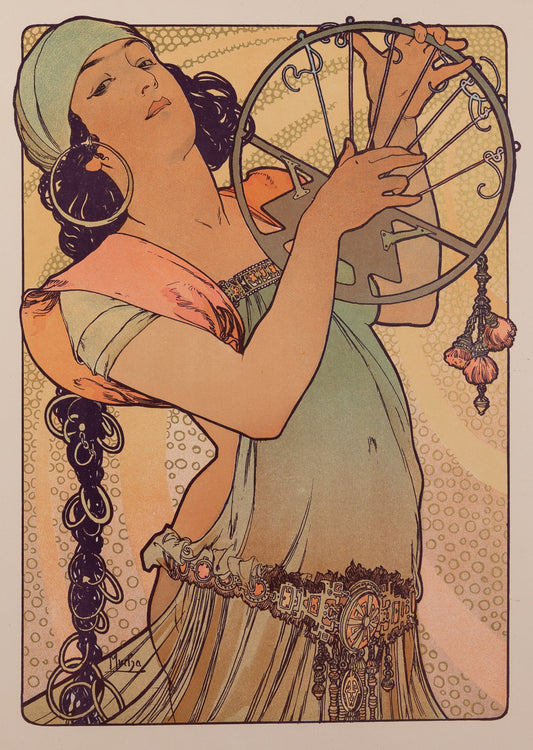
Artist: Alphonse Mucha Czech (1860-1939)
Title: Salome
Plate: em08
Original Lithograph,
issued by L'Estampe Moderne
Issue Number 2, June 1897.
Printed by F. Champenois, Paris.
Blindstamp lower right in margin.
Signed on the stone lower left "Mucha".
Presented in 16 x 20 in. acid free, archival museum mat, with framing labels. Ready to frame. Shipped boxed flat.
Certificate of Authenticity.
Sheet Size: 12 in x 16 in 30.5 cm x 40.5 cm
Price: Temporarily out of stock
I can usually source this poster. If you are interested please contact me. GregSimilar variation sold in Auction Nov 2012 $4,800.00. Poster Auctions International, NY.
A symbol of the erotic and dangerous woman, the femme fatale.
Incantation/ Salammbo, by Mucha also for L'Estampe Moderne. Click on image for details
"Mucha created expressly for the L'Estampe Moderne, a monthly portfolio of four lithographs issued between 1897 and 1899. His rendering of Salome presents the legendary temptress as a Byzantine gypsy-diaphanous apparel, raven tresses hung with rings, plucking an ancient stringed instrument, no doubt to accompany herself in the Dance of the Seven Veils." (Rennert PAI)
"In Christian mythology, Salome was the daughter of Herodias and stepdaughter of Herod Antipas, ruler of Galilee in Palestine. Her infamy comes from causing St. John the Baptist's execution. The saint had condemned the marriage of Herodias and Herod Antipas, as Herodias was the divorced wife of Antipas's half brother Philip. Incensed, Herod imprisoned John, but feared to have the well-known prophet killed. Herodias, however, was not mollified by John's incarceration and pressed her daughter Salome to "seduce" her stepfather Herod with a dance, making him promise to give her whatever she wished. At her mother's behest, Salome thus asked for the head of John the Baptist on a platter. Unwillingly, Herod did her bidding, and Salome brought the platter to her mother.
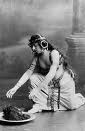
Wilde in costume as Salome
Oscar Wilde wrote his one-act play Salomé, originally written in French, to shock audiences with its spectacle of perverse passions.
Wilde's play became the source and inspiration for Richard Strauss's one-act opera also named Salomé, first produced in 1905. Herod's lust for Salome is emphasized, which Salome uses to gain her wishes by performing the famous "Dance of the Seven Veils." Salome, in turn, desires to have John the Baptist -- a new interpretation of the original myth. In the end, the only way Salome may have any part of John, quite literally, meant that she must demand his head be given to her. Salome fulfills her passion by kissing the dead lips of John's decapitated head, who had previously rejected her. This new and more familiar version of Salome depicts her as a seductress of her stepfather and a murderer of a saint, thereby becoming a symbol of the erotic and dangerous woman, the femme fatale." (Victorianweb.com)
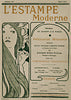
Mucha Cover
Not unlike the Maitre de L'Affiche series, L'Estampe Moderne was a portfolio printed between 1897-98, published by Imprimerie Champenois, Paris, contained 24 monthly portfolios, with four original lithographs in each. Each commissioned only for this series. Some of the contributing artists included Mucha, Rhead, Meunier, Ibels, Steinlen, Willette and Grasset.