The Great Poster Movement (A General History of Posters)
Introduction
"From the years 1890 to 1900, Europe and America were in a frenzy over a new form of advertising, which was also a new form of art: the illustrated colour advertising poster. Gone were the drab streets and boring broadsides. The boulevards of Paris, the tiny streets of Belgium and Holland, the otherwise solemn squares of London, and the shop windows of America proliferated with colourful images, a veritable public poster parade, created by some of the most talented artists of their times." (Fusco p.xiii)

Paris street picture
 (Jules Cheret) The Father of the Poster
"All the evidence that has been gathered indicates that towns (in the middle of the 19th century) were covered with posters having one point in common: an absolute lack of artistic value. The poster existed but the art of advertising had not yet been born. In order for it to develop, in order for it to be recognized, the intervention of an artist of talent was necessary. Furthermore, this artist had to be an accomplished lithographer in order to arrive at a mastery of colour. It is Jules Cheret, who is recognized, rightly, as the Father of poster art (designing over 1000 posters). From 1860, he gave the world the final impetus which allowed it to establish itself in France and the world over...he undeniably pointed the way for all Europe." (Weill p. 24,28)
 Steinlen |
 Toulouse-Lautrec |
 Mucha Mucha
|
 Cappiello |
The Artists
The great artists of Paris led the way in the poster movement. Their designs were influenced, in part, by Japanese woodcuts. This notable group headed by Cheret and including the great masters, Steinlen, Grasset, Bonnard, Willette, Forain, and the most famous artist of them all Toulouse-Lautrec. Their designs were decorating the walls of their city with lithographic masterpieces and bringing light and gaiety to a workday world. The influence of these artists spread internationally, and many of their designs have never been excelled.
Among the earlier American designers the names Rhead, Bradley, Parrish, Dow, Woodbury and Penfield stand out. In England artists including Greiffenhagen, Morrow, and Price had begun their contributions to the field, while artists like Dudley Hardy appealed alike to the critic and the man in the street by his bold groupings and strong colour arrangements. As well The Beggarstaffs, consisting of Nicholson & Pryde, perhaps the most influential graphic designers of all time, virtually created the modern poster, with clear outlines and large areas of flat colour.
Names like Mucha "The Father of Art Nouveau," and Cappiello "The Father of Modern Advertising," as well Misti, Pal, Hohenstein, Henri Meunier, De Feure, and so many others were soon added to this growing list of great poster designers whose work can now be found on display in major museums and private collections around the world.
 |
 PL 115 PL 115
|
 PL 95 |
 PL 232 |
The Subjects
"The Industrial Revolution in full swing, once basic consumer need's were covered, marketers found it profitable to create new needs, ones consumer's never knew they had. Posters were an ideal way to educate consumers about what they should want.
To convince consumers that fashion, status and convenience were as valid reasons to buy as necessity, marketing experts soon discovered the persuasive technique of showing products being enjoyed by beautiful people in beautiful settings. Pretty women soon smiled out of billboards selling everything imaginable (from gas lighting, laundry soap, medicine, cigarettes, bicycles, cookies, travel destinations, stores, art exhibitions, magazines, to wine and beer).
Posters for alcoholic beverages provide a good example of art leading the way to break a taboo. In the 19th century, drinking by women was regarded with scorn. As a result liquor ads were addressed almost exclusively to men. Knowing how persuasive men find a pretty face (and a good figure), the posterists put women in liquor posters and showed them not only praising the product but actually sampling it (such as Dubonnet, Vin Mariani, Absinthe Robette, and Mumm Champagne).
With more money and leisure time, the urban population reached out for intellectual and spiritual experiences. Now better educated, people acquired an appreciation of culture, art, and literature. As the posters for publications attest, there was a hunger for books, newspapers and magazines that brought the outside world to the reader as never before (such as Harper's, Lippincott's, Le Journal, Pan, Gil Blas, Le Rire, and La Revue Blanche)." (Gold)
With the debut of Sarah Bernhardt, and the poster that immortalized her (PL. 27), other female stars emerged, and graced the most beautiful posters ever created. Striking images of Yvette Guibert, Eugenie Buffet, Camille Stefani, Jane Avril, La Goulue, and Loie Fuller are not easily forgotten.
 PL 29 |
 PL 22 |
 PL 110 |
 PL 73 |
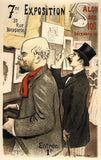
"A Sunday afternoon ritual for the folk of Paris was to journey to the dance halls set up in former windmills atop the butte of Montmartre to dance and drink wine. The Moulin Rouge opened there in 1899. With Montmarte home to as many artists as cabarets and music halls, it's not surprising the quality of entertainment posters was so high. Grun lived in the Bohemian quarter and depicted its characters as well Toulouse-Lautrec spent his most productive years, just a stroll away from the night spots he haunted." (Gold) Wonderful poster images were created for all forms of entertainment, at venues like the Moulin Rouge, including the Folies-Bergere, Olympia, Theâtre de l'Opera, and Jardin de Paris, to name a few, immortalized by the likes of Cheret, Pal, and Toulouse-Lautrec.
 PL 15 |
 PL 66 |
 PL 127 |
 PL 219 |
The First Collectors
"There was a veritable poster collecting "craze" from the late 1880's until after the turn of the century. The new and exciting medium was quickly seized upon by collectors. Poster shows and exhibitions abounded, drawing thousands of visitors, and poster collecting clubs, societies, and publications sprang up all over Europe and the United States. It was not long before poster artists and publishers realized they could overprint a commercial edition and make it available for sale through print dealers, such as Sagot in Paris. At the time the posters were issued through Sagot in the 1890's, posters such as Toulouse-Lautrec's La Revue Blanche (PL.82) sold for 5 francs (Has sold in Auction for over US $40,000). Cities were burgeoned with the rise of a new merchant class, which sought to put art into their homes. Posters were inexpensive and decorative works. In addition, illustrated advertising posters were a new notion and had given the drab streets of Paris the aspect of a public gallery. Each new poster was eagerly anticipated, talked about, and written about." (Fusco p. 40)
The Publications
"Numerous publications and periodicals fanned the fires of the poster fad. As early as 1886 publishers issued catalogs and books. Starting in 1886 under direction of Jules Cheret, a Parisian printing company started producing smaller versions of the best posters of Europe and America in lithographic plates (See Poster Printing, below). Called "Les Maitre de l'Affiche," or "Masters of the Poster," these magnificent portfolios of miniature masterworks were issued monthly for about 2 1/2 francs per issue. Each issue contained four posters, the first of which was always Cheret. In all by 1900, 256 plates had been issued (See les Maitres de l'Affiche)." (Fusco p.40) A well the French weekly publications, both humorous and satirical, had contributions from many of the great artists of the day, including Lautrec,Steinlen, Cappiello and scores of others. One of the most famous publications being "Le Rire," meaning "to laugh" (see Le Rire).
 Printing House |
 Printing House |
"In 1878, a German named Alloys Senefelder created the printing method known as lithography from the word "lithos" or stone. The ink is carried on a flat surface rather than on raised edges or in incised lines. It was not until the mid-1800's, however that the lithographic process would be perfected. It was Cheret who would refine the lithographic printing technique and master the creation of colour lithography.
In early lithographic posters, the artist or an assistant would draw the image desired onto a slab of limestone using a grease crayon (It should be noted that most posters were actually drawn on the stone or plate by a master lithographer, other than the artist, from preliminary studies, with the artist's approval and guidance).
However, most people do not realize what a cumbersome exacting process stone lithography really was. It had major drawbacks. The limestone was most often Bavarian limestone which was heavy, fragile and expensive. In addition, a separate stone was needed for each different colour of the poster. Sometimes as many as nine or ten stones were used! When the printing run was completed, often the stones were ground down to the first image and then used again for another poster.
After the ink was applied to the stone, the paper was laid on the stone, a metal backing was laid down on top, and the entire stone passed on runners under a wooden bar called a scraper, which applied pressure to lift the ink from the stone to the paper. The process had to be repeated for each colour.
Commercial printers started using roughened zinc (plates) instead of the limestone, and they were called "lithographs." ("les Maitres de l'Affiche")are lithographs printed in this manner) The distinctive feature about most lithographs (original posters) is the evenness with which the ink is applied to the paper. Under a magnifying glass one can see that the colours are evenly distributed, and it is one method of identifying a poster as a lithograph (rather than a recently printed photo offset reproduction of a lithograph which has a visible fine dot screen).
What would happen to dramatically change the way in which posters were created and printed was the advent of photography in printing. They became known as photolithographs (or photo offset, or simply offset), and it is the printing process most commonly used by commercial printers today (with digital printing becoming the next level). Most commercial (advertising) posters since World War II are photolithographs, while most posters done before World War II are lithographs. Posters which are printed by stone or zinc (plate) lithography will always be more valuable than those produced by photographic means." (Fusco pp.31-34)
 Toulouse-Lautrec painting a picture |
 PL 122 |
Investment today
In recent years rare posters by the great masters of Poster art, whose posters sold originally for a few francs, are selling for huge sums of money. Nearly one quarter of a million was paid recently for Toulouse-Lautrec's "Moulin Rouge - La Goulue". This and other works of the period will continue to rise in value.
"One of the strongest changes over the last ten years is that there is a larger and more knowledgeable group of poster collectors," says Lucy Broido (poster historian). "This is due, in part, to museum exhibitions and increased news about posters."(Fusco p.10)
Collecting Posters
"Today original posters by Chéret, Steinlen, Mucha, and Toulouse-Lautrec have far exceeded many other forms of investment. Unlike stocks and bonds, posters can be enjoyed for their beauty as well as their investment values in the global art market.
Investment value aside, the true collector collects for the love of the art itself. You should collect what you like, and expand your interest slowly based upon looking at posters. This is exactly what they were designed for, to deliver a message to you, to be admired, to be remembered, and now most of all, to be enjoyed."
Greg Yaneff, Director